
The secret may have less to do with how many books you buy — and more to do with what happens when you open one.
You buy the colourful books.
You create a little bookshelf.
You tell your child, “Go read.”
And then you wonder why the books remain untouched.
Here’s the interesting part: research suggests that raising a reader isn’t simply about putting more books in the house.
What parents do around reading matters.
Research on shared book reading consistently links regular, interactive reading experiences with children’s language and literacy development. A 2020 systematic review and meta-analysis of 19 randomized controlled trials involving 2,594 children found that book-sharing interventions produced measurable improvements in children’s expressive and receptive language.
So if you want your child to genuinely enjoy reading, start with these three habits.
1. Start Before Your Child Can Read
Don’t wait for the first day of school.
One of the biggest mistakes parents make is thinking:
“I’ll start reading with my child when they are old enough to understand the story.”
But your child doesn’t need to know the alphabet to benefit from a book.
The American Academy of Pediatrics recommends shared reading starting from birth and continuing through at least kindergarten. Reading together can support language development, early literacy and the parent-child relationship.
For a baby, reading might mean looking at pictures.
For a toddler, it might mean pointing at a dog and saying, “Where’s the dog?”
For a preschooler, it might mean asking what they think will happen next.
The goal isn’t to finish the book.
The goal is to make books a normal part of life.
Think of it like brushing teeth.
You don’t wait until your child develops a cavity to introduce the toothbrush.
Similarly, don’t wait until school starts to introduce books.
Try this tonight:
Pick 10 minutes.
Sit together.
Put the phone away.
Read slowly.
Let your child interrupt.
That last part is important.
2. Stop Reading To Your Child. Start Reading With Them.
The book should become a conversation.
Imagine two parents reading the same story.
Parent A reads every page perfectly while the child listens quietly.
Parent B stops occasionally:
“Why do you think she did that?”
“What do you think happens next?”
“Have you ever felt like that?”
“Can you find something red in this picture?”
Which experience is more interactive?
Research supports this difference.
A meta-analysis of 38 studies involving 2,455 children found that dialogic reading approaches — where children actively participate in the reading — can influence word learning.
The American Academy of Pediatrics also highlights interactive approaches such as dialogic reading, where books are used to encourage back-and-forth conversation between the child and caregiver.
So don’t worry if your child doesn’t sit silently through the entire story.
A child who interrupts with:
“But why?”
may actually be doing exactly what you want.
Try this simple rule:
Read a little.
Ask a little.
Listen a lot.
You don’t have to turn story time into a lesson.
Just be curious together.
3. Let Your Child Choose Sometimes
Your child doesn’t have to love the books you loved.
You might want your child to read classic literature.
Your child wants dinosaurs.
You offer a beautiful story.
They choose a book about space for the seventh time.
Let them.
A child’s reading journey doesn’t have to begin with the book you think is important.
It can begin with the book they can’t put down.
Research on the home literacy environment points to children’s interest and engagement as important parts of developing reading and language skills. The AAP also recommends access to high-quality, developmentally appropriate and culturally diverse books in languages that work for the family.
That means comics can count.
Picture books count.
Non-fiction counts.
Books about football count.
Books about animals count.
Books in Hindi, English or another language spoken at home count.
The first goal isn’t to create a child who reads “serious” books.
It’s to create a child who thinks:
“Books are for me.”
And Here’s What Parents Often Get Wrong
We sometimes turn reading into another school assignment.
“Have you finished your reading?”
“How many pages did you read?”
“What did you learn?”
“Tell me the moral of the story.”
Soon, something that could have been relaxing starts feeling like homework.
The research doesn’t suggest that parents need to become teachers at bedtime.
Quite the opposite.
The AAP describes shared reading as a joyful, language-rich interaction and emphasises positive relationships around books.
So sometimes, just read.
Laugh at the silly character.
Make a funny voice.
Talk about the picture.
Let your child choose the next book.
And occasionally…
don’t finish the story.
Let them ask you tomorrow:
“Can we read that again?”
That’s a good sign.
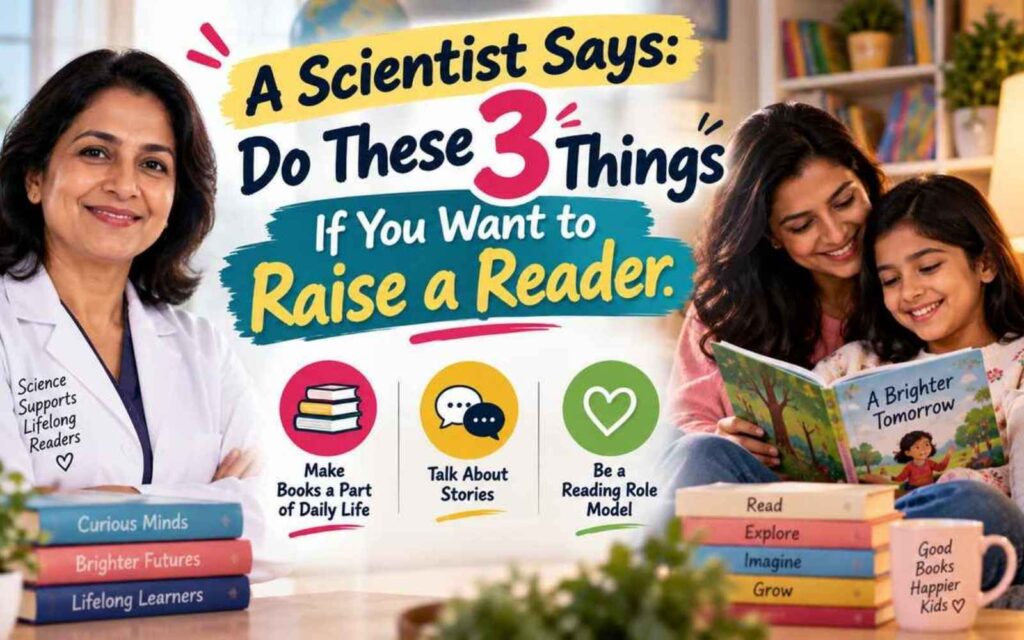
The 3-Part Formula
If you remember nothing else, remember this:
📖 MAKE IT ROUTINE
Read regularly, starting early.
💬 MAKE IT INTERACTIVE
Talk, ask questions and let your child participate.
❤️ MAKE IT THEIRS
Let children explore books, subjects and languages that genuinely interest them.
Because the goal isn’t simply to teach a child how to read.
It’s to help them discover why they want to read.
And that difference can last a lifetime.
ONE LAST THOUGHT FOR PARENTS
Don’t measure your child’s reading journey only by the number of books on the shelf.
Measure it by the moments when your child picks up a book without being asked.
That is when reading stops being a task…
and starts becoming a habit.
