
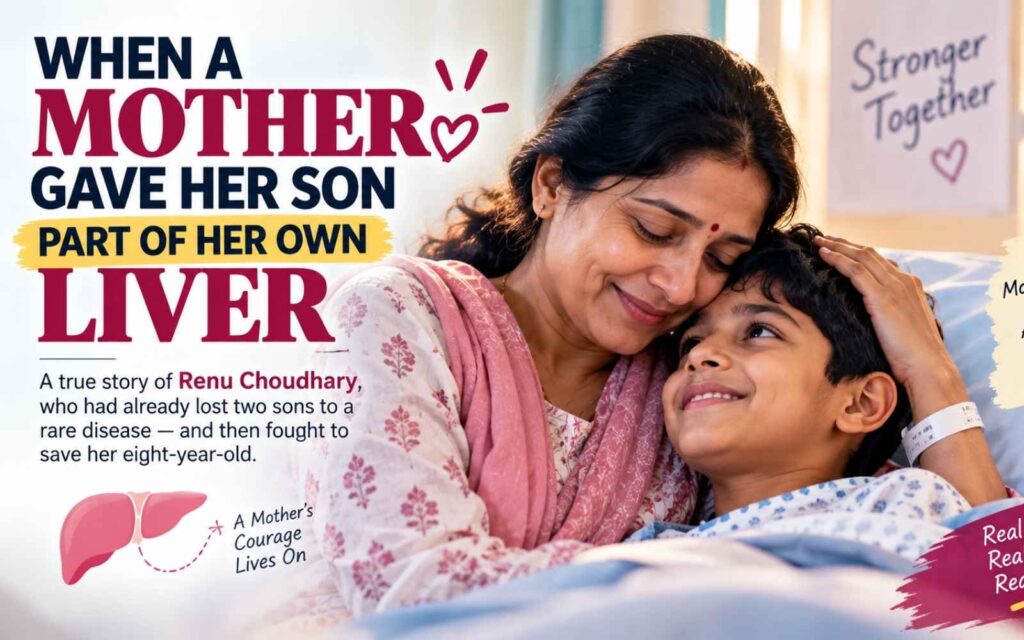
A true story of Renu Choudhary, who had already lost two sons to a rare disease — and then fought to save her eight-year-old.
Sometimes, a mother’s courage doesn’t look dramatic.
There is no audience.
No applause.
No camera waiting to capture the moment.
Sometimes, it is simply a mother sitting beside her sick child in a hospital, listening to doctors say that there may not be much time.
For Renu Choudhary, that moment came after her family had already experienced a heartbreak no parent should have to endure.
She had lost two sons to the same rare genetic disease.
Then her youngest son, eight-year-old Badal, became critically ill.
And this time, Renu refused to let the story end the same way.
THE DISEASE THAT HAD ALREADY TAKEN TWO SONS
Badal, a Class 4 student, was suffering from Wilson’s disease — a rare inherited disorder in which excessive copper accumulates in the body and can severely damage organs, particularly the liver and brain.
By the time Badal was brought to Marengo Asia Hospitals in Faridabad, his condition had become critical.
His jaundice was severe.
His abdomen had developed infected fluid.
And his liver was failing.
Doctors knew that this was no longer a situation where they could simply wait and see.
He needed a liver transplant.
There was also a painful history hanging over the family.
They had already lost two sons to the same disease.
For Renu and her family, the fear wasn’t new.
They knew exactly what they could lose.
THE ANSWER WAS SITTING BESIDE HIM
When doctors determined that Badal needed a transplant urgently, the family needed a suitable donor.
Renu volunteered.
She was 40 years old.
She was also his mother.
After medical evaluation confirmed that she was fit to donate, she made the decision to give a portion of her own liver to her son.
It was not a symbolic gesture.
It was major surgery.
And it meant that while her son would be fighting for his life on one operating table, she would be undergoing surgery herself.
In December 2025, doctors performed the transplant.
The operation lasted approximately 12 to 13 hours.
A portion of Renu’s liver was transplanted into Badal.
Two lives were now recovering from one extraordinary operation.
THE MOMENT AFTER THE SURGERY
The story could have ended with the operation.
It didn’t.
Both mother and son recovered successfully.
Badal was discharged from the hospital around three weeks later, and doctors reported that he was healthy and living a normal life.
For a family that had already lost two children to the same illness, the outcome carried a meaning that a medical success statistic can never fully explain.
One child had survived.
One mother had given him a part of herself.
AND THAT IS WHAT MAKES THIS STORY DIFFERENT
We often describe mothers as “selfless.”
The word appears so often that sometimes it loses its meaning.
Renu’s story reminds us what that word can actually look like.
It can look like fear — and choosing courage anyway.
It can look like knowing the risks — and still stepping forward.
It can look like sitting beside your child while doctors explain the seriousness of the situation, then saying, in effect:
“Test me. If I can help my child, I will.”
A MOTHER IS NOT A SUPERHERO
Perhaps that is the most important part of this story.
Renu wasn’t a superhero.
She didn’t have special powers.
She was a mother facing something terrifying.
She had already experienced the loss of two children.
And when her youngest needed help, she did what many mothers do every day in ways that rarely make the news:
She showed up.
She stayed.
She hoped.
And when there was something she could personally do, she stepped forward.
THE SCIENCE BEHIND THE MIRACLE
A liver transplant is possible because the human liver has a remarkable ability to regenerate.
In a living-donor liver transplant, surgeons can remove a suitable portion of the donor’s liver and transplant it into the recipient. Over time, the remaining liver in the donor and the transplanted portion in the recipient can grow toward their appropriate functional volume.
But that doesn’t make the decision easy.
Living donation requires careful medical screening, assessment of compatibility and a detailed evaluation of risks to the donor as well as the recipient.
In Renu’s case, doctors first confirmed that she was medically fit to donate before proceeding with the surgery.
WHY WILSON’S DISEASE MATTERS
Wilson’s disease is rare, but its story is important for parents because it is an inherited condition.
The disorder causes the body to accumulate too much copper because it cannot process and eliminate it normally.
The liver and brain are among the organs that can be affected.
Symptoms can vary considerably, and early signs may not always point clearly to the disease. This is one reason medical evaluation is important when a child develops unexplained liver problems or other concerning symptoms.
Doctors say early diagnosis and appropriate treatment can be critical in preventing serious organ damage.
THE PART WE DON’T SEE
News stories usually begin when something extraordinary happens.
But a mother’s real journey often begins much earlier.
The hospital visits.
The worrying test results.
The sleepless nights.
The questions nobody can answer immediately.
The memories of what happened before.
The fear of hearing the same diagnosis again.
Renu’s story is not only about the day she donated part of her liver.
It is also about everything that came before that decision.
She was not simply fighting a medical condition.
She was fighting the possibility of losing another child.
AND THEN CAME THE GOOD NEWS
The transplant worked.
Mother and son recovered.
Badal went home.
And a family that had known unimaginable loss finally had something different to hold on to:
Hope.
A FINAL THOUGHT FOR EVERY PARENT
We often say that parents would do anything for their children.
Renu Choudhary’s story shows what those words can mean when they are tested in the hardest possible circumstances.
She could not change the past.
She could not bring back the two sons her family had lost.
But when her youngest son needed a chance, she gave him one.
Not with words.
Not with promises.
But with a part of herself.
That is why some mothers don’t need a cape to be called heroes.
Sometimes,
THE HERO IS SIMPLY MOM.
SOURCE NOTE
This story is based on a report published by The Times of India on May 10, 2026, based on information shared by doctors at Marengo Asia Hospitals, Faridabad. The report identified the mother as Renu Choudhary, described her as the wife of an Army personnel from Jammu and Kashmir, and reported that the transplant took place in December 2025.
Medical information about Wilson’s disease and liver transplantation has been presented for general awareness and should not be considered personal medical advice.
