
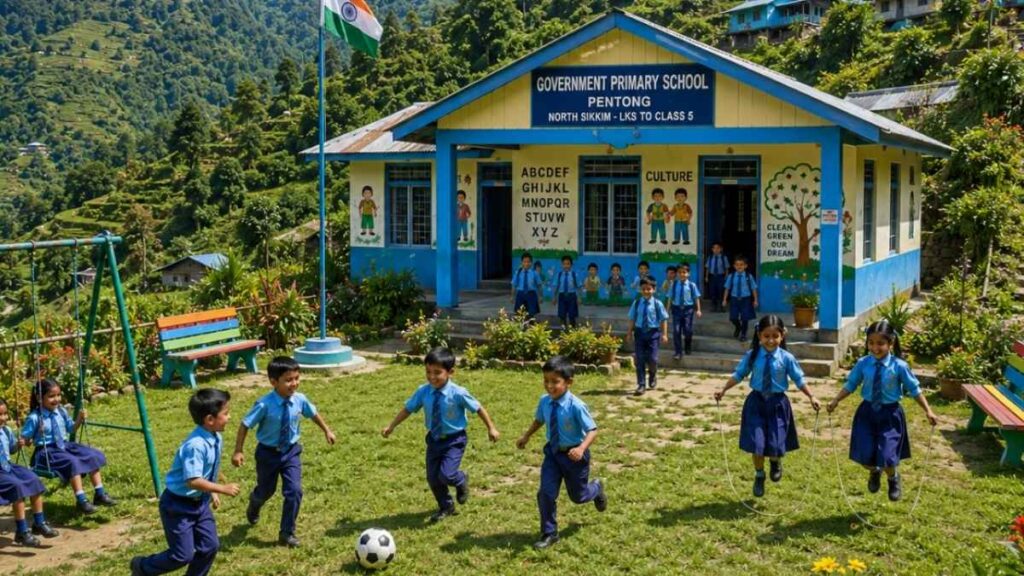
Government Primary School, Pentong, North Sikkim
Three hours of off-road travel. A river crossing. More than 100 stairs.
And at the end of that difficult journey, a school where just 18 children come to learn.
There are schools with huge campuses.
Schools with swimming pools, laboratories, smart classrooms and thousands of students.
And then there is Government Primary School, Pentong, tucked away in the remote mountains of North Sikkim.
It doesn’t have the easiest location.
It doesn’t have hundreds of students.
But its story is a powerful reminder that a child’s right to education shouldn’t depend on how easy it is to reach their village.
WELCOME TO PENTONG
Pentong is a remote village in the Dzongu region of North Sikkim.
Getting there is not like taking a school bus through a city neighbourhood.
Recent visitors documenting the journey reported around three hours of off-road travel, a difficult river crossing and a climb of more than 100 stairs before reaching the school.
There is also limited connectivity in the area, making everyday life considerably more challenging than in India’s cities.
Yet, after making that difficult journey, visitors find something unexpected.
A school that feels cared for.
JUST 18 STUDENTS
The school currently serves only 18 children, from LKG through Class 5.
Four teachers look after the students.
At first glance, 18 may sound like a remarkably small number for an entire school.
But in a remote mountain community, every child matters.
The school provides a place where children from surrounding areas can study without having to leave their region simply to receive a basic education.
And for several children, the school is more than just a classroom.
It is their second home.
A HOSTEL IN THE MOUNTAINS
One of the most remarkable aspects of Pentong is that the school has government-funded hostel facilities.
This matters because many students do not live immediately beside the school.
According to reporting on the school, only one of the 18 children is from Pentong itself, while other students stay in the hostel.
That means the school isn’t simply providing classrooms.
It is helping make education possible for children who live in extremely difficult-to-reach areas.
AND THEN THERE IS THE PLAYGROUND
You might expect a remote government school to have little more than a basic classroom.
Pentong surprises you.
The school has a well-maintained playground, organised classrooms and colourful educational material decorating the walls.
The surroundings are almost cinematic.
Green mountains.
Fresh air.
Quiet valleys.
And children playing in a schoolyard far removed from the noise of India’s cities.
It is a very different picture of what an Indian school can look like.
THE TEACHER WHO WENT BEYOND THE CLASSROOM
Behind the school is another important part of the story.
The school’s teacher and in-charge, Clock Lepcha, didn’t simply wait for children to arrive.
According to the reporting, he went into nearby villages, spoke with parents and encouraged them to send their children to school.
He also helps students return to their villages during the summer holidays.
That kind of effort is easy to overlook.
But in a remote region, getting children into school can sometimes be just as important as teaching them once they arrive.
WHEN GEOGRAPHY BECOMES THE BIGGEST CHALLENGE
For families living in cities, choosing a school often means comparing:
Fees.
Curriculum.
Distance.
Facilities.
Sports.
Activities.
University results.
But for a family in a remote Himalayan village, the question can be much more basic:
Is there a school my child can actually reach?
Pentong answers that question with determination.
The journey may be difficult.
The weather may be unpredictable.
The terrain may be challenging.
But the school remains.
A SCHOOL WITHOUT THE LUXURY OF BEING CONVENIENT
There is something deeply moving about Pentong.
The school isn’t extraordinary because it has the most expensive facilities in India.
It isn’t extraordinary because famous people studied there.
It isn’t extraordinary because it has thousands of students.
It is extraordinary because it exists where it is needed.
That may sound simple.
But education in remote communities often depends on exactly that kind of commitment.
WHAT MAKES A GREAT SCHOOL?
Ask ten parents this question and you might get ten different answers.
Some will say academic results.
Others will say discipline.
Some will choose sports.
Others will talk about technology.
But Pentong offers another answer.
A great school is a place that gives children the opportunity to imagine a future beyond the limitations of their surroundings.
The mountains may surround them.
But their dreams don’t have to stop there.
THE 100-STEP LESSON
There is something symbolic about the more than 100 stairs leading to this school.
For some children, reaching a classroom takes a few minutes.
For these children, it takes effort.
But perhaps those steps teach something before the first lesson has even begun.
That learning is worth the journey.
That opportunity is worth reaching for.
And that where you are born should not decide how far you can go.
WHAT URBAN PARENTS CAN LEARN FROM PENTONG
Modern parents sometimes find themselves caught in an endless race.
Is this school better?
Does that school have better facilities?
Should my child learn coding?
Should they play another sport?
Should they join another activity?
Pentong offers a quiet perspective.
Children don’t necessarily need everything.
They need someone who believes their education matters.
They need teachers who care.
They need a safe place to learn.
They need opportunities to explore.
And most importantly, they need adults who refuse to tell them that their circumstances define their future.
NOT THE BIGGEST. NOT THE MOST EXPENSIVE.
But perhaps one of the most meaningful.
Government Primary School, Pentong may never appear on a list of India’s most expensive schools.
It may never have a celebrity alumnus.
It may never have a campus filled with thousands of students.
But every morning, children make their way towards it.
Some come from nearby.
Others stay in the hostel.
They walk into classrooms.
Open their books.
Learn something new.
Play with their friends.
And go home knowing a little more about the world than they did yesterday.
That is what a school is supposed to do.
THE SCHOOL AT THE END OF THE ROAD
Imagine being a child growing up in one of the remotest corners of India.
Your world is surrounded by mountains.
The nearest conveniences may be far away.
Mobile connectivity may not always be available.
And yet, there is a school waiting for you.
A teacher waiting for you.
A classroom waiting for you.
A playground waiting for you.
And perhaps, most importantly…
a future waiting for you.
That is why Government Primary School, Pentong deserves to be called extraordinary.
Not because it has everything.
But because it proves that education can find its way almost anywhere.
SCHOOL AT A GLANCE
NAME: Government Primary School, Pentong
LOCATION: Pentong Village, Dzongu, North Sikkim
TYPE: Government Primary School
STUDENTS: 18
CLASSES: LKG to Class 5
TEACHERS: 4
FACILITIES: Classrooms, playground and government-funded residential hostel
WHAT MAKES IT SPECIAL: Its extremely remote location, difficult journey and commitment to providing education to children from surrounding mountain communities.
SOURCE NOTE
This article is based on recent reporting about Government Primary School, Pentong, published by The Economic Times in June 2026. The report documented the difficult journey to the school, its 18 students, four teachers, hostel facilities and the efforts of teacher-in-charge Clock Lepcha to encourage children from surrounding villages to attend.
The school’s existence and location are also reflected in official Sikkim government records, which list Govt. Pry School, Pentong in the Dzongu area.
